

Sheikh Hamad Award for Translation to Discuss the Role of Translation in Fostering Intercultural Understanding
Doha to Host a Seminar Featuring Leading Academics, Researchers and Translators from Around the World
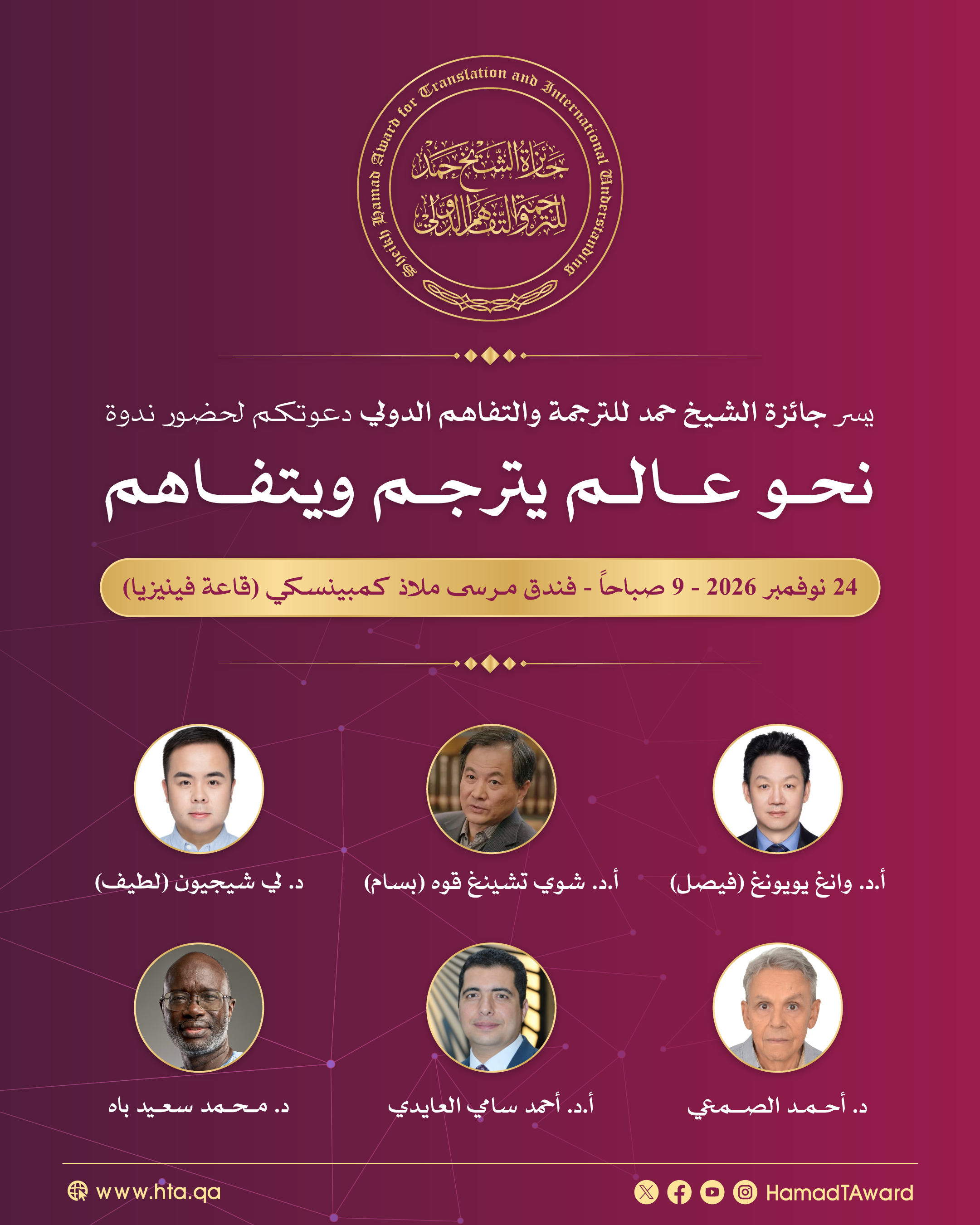
As part of its efforts to promote cultural dialogue and expand opportunities for knowledge exchange among peoples, the Sheikh Hamad Award for Translation and International Understanding will hold a seminar entitled “Towards a World of Translation and Mutual Understanding” on the morning of Tuesday, November 24, 2026. Bringing together distinguished academics, researchers and translators from around the world, the seminar will explore the role of translation in building bridges between cultures and its potential to address the intellectual and knowledge-related challenges facing the world today. The event will take place on the same day as the award ceremony honoring the winners of the Award’s 12th edition.
The seminar forms part of the Award’s ongoing efforts to foster intellectual and cultural dialogue among peoples and highlight the role of translation in promoting mutual understanding and knowledge exchange amid rapid scientific and technological advances and growing geopolitical and cultural challenges. It addresses a fundamental paradox: while technological developments have greatly expanded our capacity to translate and communicate, profound gaps in knowledge and cultural understanding persist. This raises a central question: Does greater capacity for translation and communication necessarily lead to deeper understanding among peoples?
The seminar seeks to explore this question from a perspective that goes beyond conventional discussions of translation, examining its relationship with intellectual and scientific developments and the challenges facing the contemporary world. The program comprises two academic sessions featuring six presentations, followed by interactive discussions with the audience.
Session One: Translation Between Arabic and Chinese in a Multipolar World
The seminar will begin at 9:00 a.m. with the first session, entitled “Translation Between Arabic and Chinese in a Multipolar World,” chaired by Professor You Mei, Professor of Arabic Studies at Beijing Foreign Studies University.
The session will examine the role of translation in strengthening mutual understanding between the Arab world and China, particularly in light of China’s growing influence in the global economy, technology and international relations. It will also explore the extent to which translation has kept pace with scientific and intellectual developments in China, its role in overcoming stereotypes and indirect perceptions shaped by intermediary languages, and whether cultural exchange has kept pace with the expanding economic and political ties between China and the Arab world.
Professor Wang Youyong (Faisal), of Shanghai International Studies University, will deliver a presentation entitled “Translating Chinese Classics into Arabic in a Multipolar World.” His presentation will examine the translation of classical Chinese works into Arabic and their contribution to introducing Arab readers to China’s intellectual and cultural heritage.
Dr. Li Shijun (Latif), researcher and Assistant Professor at the China-Arab Research Center on Reform and Development at Shanghai International Studies University, will present “Key Milestones in the Translation of Arabic Works into Chinese: A Regional and Country Studies Perspective.” His presentation will trace the development of Arabic-to-Chinese translation within the broader context of regional studies and cultural relations between China and the Arab world.
Professor Xue Qingguo (Bassam), of Beijing Foreign Studies University, will deliver a presentation entitled “Translation Between Chinese and Arabic as a Reflection of Social and Intellectual Transformations in China.” He will explore the relationship between translation and the transformations that have shaped Chinese society and contemporary thought. Professor Xue is a prominent translator working between Arabic and Chinese and received the Sheikh Hamad Award for Translation and International Understanding in 2017.
Session Two: Translation and Perspectives on the World
The second session, entitled “Translation and Perspectives on the World,” will begin at 11:00 a.m. and will be chaired by Dr. Sidna Sidatie, Professor at the University of Nouakchott in Mauritania and Director of the Africa Tomorrow Foundation in Dakar, Senegal.
Drawing on translation experiences involving Azerbaijani, Italian and Fulani, the session will examine the relationship between language, knowledge and power, as well as inequalities in the opportunities available to different cultures to reach international audiences. It will also address the influence of linguistic dominance on the production and circulation of knowledge, and the role of translation in preserving cultural diversity and collective memory while enabling less-represented cultures to participate more fully in the creation and exchange of knowledge.
Professor Ahmed Sami, Professor of Azerbaijani Language and Literature at Ain Shams University, will present “Translation and Knowledge Exchange Between Arabic and Azerbaijani in the Context of Linguistic Hegemony.” His presentation will examine the challenges facing knowledge exchange between languages amid disparities in cultural visibility and influence.
Dr. Somai Ahmed, Professor of Modern and Contemporary Italian Language and Literature at the University of Tunis, will deliver a presentation entitled “A Vision of the Universe Through the Translation of Umberto Eco’s The Name of the Rose.” He will explore the novel’s historical and cultural dimensions, the reconstruction of the medieval world through translation, and the transition from a conception of the physical universe to the interpretation of the literary text.
The final presentation will be delivered by Dr. Mohamed Saidou Ba, a researcher and translator specializing in intellectual history, political history and literature. Entitled “Translation as a Forward-Looking Vision for Restoring the Value of Human Fraternity in a Troubled World,” his presentation will examine how translation can contribute to strengthening human fraternity and intercultural understanding amid the tensions facing the contemporary world.
The seminar forms part of the intellectual and cultural activities organized by the Sheikh Hamad Award for Translation and International Understanding, reaffirming its mission to promote translation as a means of bringing cultures closer together, strengthening international understanding and enriching knowledge exchange between Arabic and the languages of the world.
Later that evening, Doha will host the award ceremony for the winners of the 12th edition of the Sheikh Hamad Award for Translation and International Understanding. The ceremony will feature the announcement of this year’s results and honor outstanding works and achievements in translation between Arabic and other world languages.
Click here to download the seminar program